
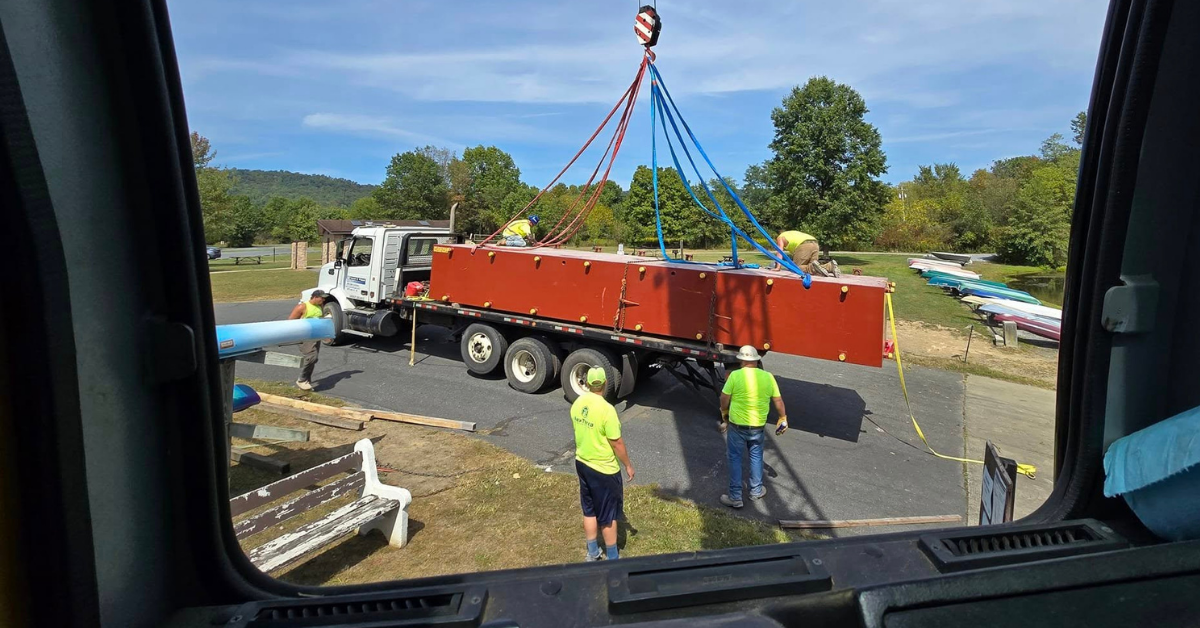
Versatile Crane Rentals provides crane service for general contractors, developers, and subcontractors building across Lancaster County, PA, from structural steel and roof trusses to precast panels, concrete forms, and heavy material sets. We work off your project schedule, not the other way around, coordinating directly with your site super so the crane shows up when your crew is actually ready for it. We run 24/7, including calls where a delayed delivery or a weather window means the lift has to happen outside normal hours.
Bidding a project that needs crane support? Call (717) 875-5343 before you finalize your schedule. Knowing your crane logistics early keeps steel, trusses, and material sets from becoming the thing that holds up the rest of the job.
What Is a Construction Crane Lift
A construction crane lift uses a mobile or hydraulic crane to move heavy building materials, structural steel, trusses, or prefabricated components into place on a job site, usually because the weight, height, or reach is beyond what a forklift or rigging crew can handle safely.
When Do You Need a Crane on a Construction Project
You need a crane whenever material has to go up higher than a forklift can reach, over an obstruction, or into a position too precise for hand rigging. That covers structural steel erection, roof truss sets, tilt-up or precast panels, HVAC curbs and rooftop equipment, and material hoisting to upper floors on multi-story builds.
How Long Does a Construction Crane Lift Take
A single truss set or steel delivery often wraps in a few hours. Full structural steel erection, multi-day panel installs, or projects with several separate lifts run longer, and we scope the actual timeline once we know your sequence and site access, not off a flat day rate.
What We Lift
- Structural steel beams, columns, and connections
- Roof trusses and prefabricated wall panels
- Precast and tilt-up concrete panels
- HVAC equipment and rooftop mechanical sets
- Material hoisting to upper floors and rooftops on active builds
Why Construction Lifts Take More Planning
A structural steel lift isn’t just about weight. It’s about sequence: steel has to land in the right order for the erector to bolt and plumb it before the next piece goes up, which means the crane’s schedule has to match the erector’s schedule, not just show up sometime that day. Panel and truss lifts carry a different risk, since a gust of wind on a large flat surface acts like a sail, and that changes what the crane can safely handle that hour, not just that day.
Ground conditions matter just as much as the load. Outrigger pads need solid, level ground to hold a crane’s rated capacity, and a lot of active job sites have exactly the opposite: fresh backfill, mud, or a foundation excavation sitting right where the crane needs to set up. We check this during the site review, not after the crane’s already there and stuck.
How the Lift Works
- Site review: We walk the access, ground conditions, and overhead obstructions before quoting, since the site usually determines the crane size more than the load does.
- Rigging plan: We confirm weight, dimensions, and rigging points for steel, trusses, panels, or whatever’s going up, so the crane and rigging match the actual pick.
- Scheduling with your crew: We build the lift around your erector, framer, or GC’s sequence, not a generic time slot, so the trades on-site aren’t standing around waiting.
- The lift: Our operator sets each piece with your foreman confirming placement before anything is unhooked.
- Site cleared: Crane and rigging move off once the day’s lifts are done, so you’re not paying for equipment sitting idle between picks.
We run mobile and hydraulic cranes sized to the job, with rigging planned around load charts, tag lines, and spreader bars rated for the specific pick, not a default setup used for every job regardless of what’s going up.
That planning is what protects your schedule more than anything else. A crane that shows up sized wrong, or scheduled without your erector’s sequence in mind, doesn’t just slow down our part of the day. It backs up every trade behind it.
Need multiple lift days across one project? Tell us the phase schedule up front and we’ll plan crane support around it instead of booking single trips for each phase separately.
Coordinating HVAC and Generator Sets on the Same Job
Plenty of general construction projects also need HVAC or generator equipment set once the building’s dried in. If that’s part of your scope, we can plan it under the same mobilization as your structural lifts. See our HVAC & Generator Crane Service page for that scope specifically.
Crane Safety Requirements and Certified Operator Standards
Structural steel work falls under OSHA’s Steel Erection standard (29 CFR 1926 Subpart R), which governs site layout, erection sequence, and fall protection during steel work. Crane operator certification runs through accredited third-party bodies, most commonly the NCCCO, the industry’s recognized certifying organization. If certification or insurance documentation is something your GC requires before mobilization, ask us directly and we’ll provide what’s needed before the crane arrives.
What Drives the Cost
- Crane size and reach: taller structures or tighter urban lots often need a larger or more specialized crane than open, single-story sites.
- Rigging complexity: structural steel and panel lifts rig differently than a straightforward material set.
- Number of lift days: a single delivery costs less than a multi-day steel erection sequence.
- Site access: active excavation, limited street access, or overhead lines add planning time and sometimes permitting.
We walk through these before quoting, so your number reflects the actual job and sequence, not a flat day rate that ignores your site.
Areas We Serve
We serve general contractors and developers throughout Lancaster County, including Lancaster, Columbia, Lititz, Ephrata, Elizabethtown, New Holland, Harrisburg, Hershey, Lebanon, York, and Reading, with coverage extending to Carlisle, Coatesville, Downingtown, Hanover, Kennett Square, Middletown, Oxford, Palmyra, Parkesburg, Phoenixville, Pottstown, West Chester, and Wilmington. Check our full service area for exact coverage, or call and we’ll confirm your site before you lock in a lift date.

