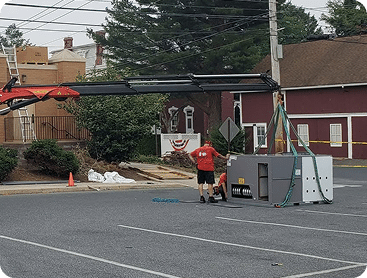
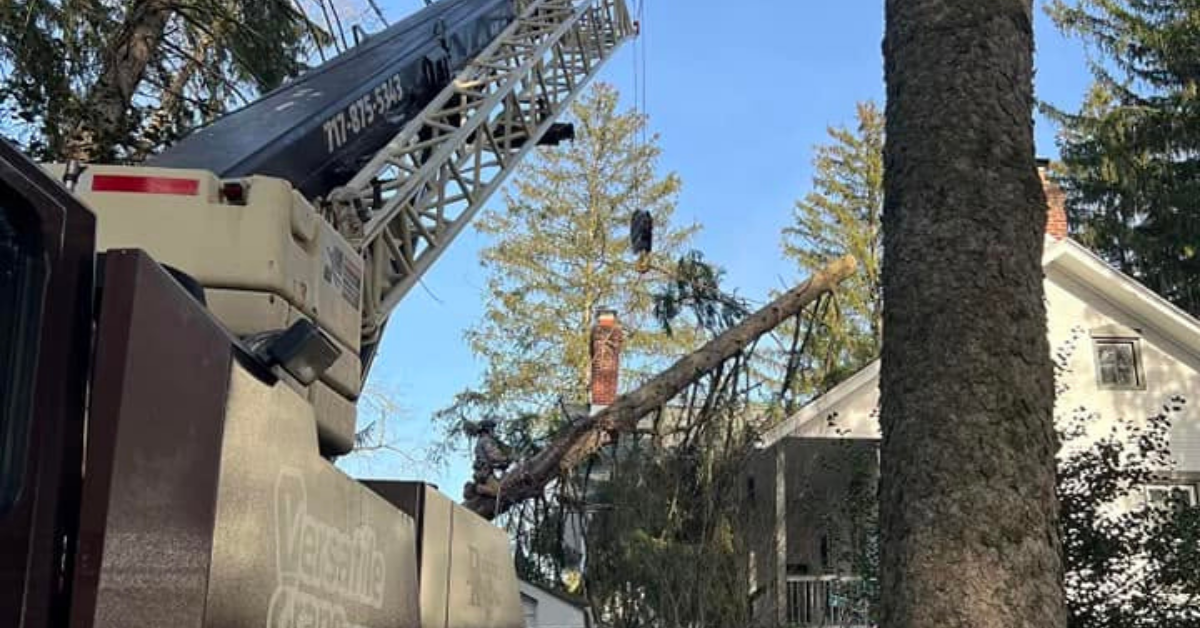
Versatile Crane Rentals provides emergency crane service and rapid crane dispatch across Lancaster County, PA, responding to storm damage, equipment failure, construction breakdowns, and other time-sensitive lifts that standard scheduling can’t cover.
Emergency calls receive priority scheduling whenever operationally possible, and we dispatch a crane sized to the actual hazard, not just whatever’s closest, so the situation gets resolved correctly the first time instead of needing a second visit.
Dealing with an emergency right now? Call (717) 875-5343. Tell us what’s happening and where, and we’ll get a crane moving while we confirm the details.
What Happens When You Call
- We ask what happened and what’s currently at risk.
- We confirm your exact location and site access.
- We identify the hazard so we know what we’re actually dealing with.
- We determine the crane size and rigging the situation needs.
- We dispatch the crane, operator, and rigging equipment best suited to the situation, often before every detail has been confirmed.
What Is Emergency Crane Service?
Emergency crane service is 24-hour crane service dispatched outside normal scheduling for situations that pose an immediate risk to people or property, or that would cause significant loss if they waited for a standard appointment, such as storm damage, equipment failure, or a breakdown mid-project. It typically means an emergency mobile crane arriving with an operator ready to assess and resolve the hazard on-site, not just deliver equipment.
When Do You Need Emergency Crane Service?
You need emergency crane service when a hazard can’t safely wait: a tree or limb threatening a structure or power line, a failed generator during an outage, a broken-down crane holding up an active job site, or any situation where delay increases the risk or the cost.
How Fast Can You Respond to an Emergency Call
An urgent crane response depends on your location within our service area, the time of day, and what the situation requires, so we won’t quote a fixed number that isn’t honest for every call. What we can tell you is that urgent requests are assessed immediately and scheduled as quickly as available equipment and site conditions allow, and we start moving a crane while we’re still confirming the details with you.
What We Handle on Emergency Jobs
- Storm-damaged or hazardous trees threatening a structure, vehicle, or power line
- Failed generators during a power outage, especially at facilities that can’t afford downtime
- Collapsed or failed HVAC and rooftop equipment during extreme heat or cold
- A broken-down crane or lifting equipment stalling an active construction site
- Industrial equipment failures and manufacturing or warehouse incidents requiring urgent lifting
- Accident or breakdown recovery requiring heavy lifting
- Containers or cargo blocking access that need to move immediately
- Storm-damaged utility poles or debris blocking roads or property access, coordinated with the utility or restoration crew handling the electrical work
- Cell tower and telecom equipment emergencies requiring urgent crane support
Why Emergency Lifts Still Take Real Planning
Emergency doesn’t mean skipping the steps that keep a lift safe. It means compressing them. We still confirm ground conditions, overhead hazards, and rigging points before the crane picks anything up, because a rushed lift with the wrong crane or bad rigging turns one emergency into two. What changes under emergency conditions isn’t the process, it’s the pace: we triage by phone, move equipment while confirming details, and make site decisions faster because the situation demands it, not because we’re cutting corners on safety.
That matters most with storm damage and structural risk, where the hazard itself (a leaning tree, a compromised roof, unstable debris) can change between when you call and when the crane arrives. We reassess on-site before every lift, even one we planned five minutes ago by phone.
Storms, high winds, flooding, and ice frequently create the exact situations that need emergency crane support: downed trees, damaged rooftop equipment, and blocked access. Weather also affects whether and how a lift can safely happen, since high wind in particular limits what a crane can handle regardless of how urgent the situation is. We evaluate current conditions as part of every emergency response, not just the hazard itself, to confirm the lift can be completed safely.
Our Process
- Rapid site assessment: Our operator confirms the hazard, access, and ground conditions on arrival, since phone descriptions don’t always match what’s actually there.
- Crane and rigging setup: We bring equipment sized to the situation, not a default machine, and rig for the specific hazard or load.
- The lift: We resolve the immediate hazard, whether that’s removing a tree, replacing a failed generator, or freeing a stalled piece of equipment.
- Site secured: We confirm the site is safe before we leave, not just that the immediate lift is done.
Coordinating with your insurance adjuster or another contractor on-site? Let us know when you call. We can work alongside restoration crews, tree companies, or your GC without you having to manage the handoff yourself.
Emergency Crane Services We Commonly Provide
Most of our emergency lifting services fall under one of our core industries, just on an urgent timeline instead of a scheduled one. See HVAC & Generator Crane Service for failed generators and rooftop units, General Construction Crane Service for a breakdown mid-project, Tree & Landscape Crane Service for storm-damaged trees, and Container & Cargo Crane Service for cargo blocking access. Call us either way. We’ll route the right equipment once we know what’s happening.
Emergency Crane Safety and Certification
Emergency calls still fall under the same OSHA Cranes & Derricks in Construction standard that governs every crane lift we run, and operator certification still runs through accredited bodies like the NCCCO. Working fast isn’t a reason to skip a safety step, and if anything an emergency site (storm debris, an unstable structure, an active outage) is exactly where that standard matters most. If your insurance carrier or GC needs documentation, ask us directly and we’ll provide it.
What Drives the Cost
We understand emergency situations are stressful, and cost shouldn’t be another unknown on top of everything else. Once we understand the scope of the lift, we’ll explain the expected cost before work begins whenever the situation allows.
- Time of call: after-hours crane service, weekend calls, and holiday emergency work typically cost more than standard scheduling.
- Crane size and complexity: a hazardous tree over a house or a large generator swap needs more planning than a straightforward pick.
- Site conditions: storm debris, unstable ground, or limited access add setup time even on an urgent call.
- Coordination: working alongside an adjuster, restoration crew, or another contractor doesn’t add crane cost directly, but it can affect scheduling.
We’ll give you a real number as soon as we know what we’re dealing with, even on an emergency call. We don’t add unexplained fees once the crane is already on-site.
Emergency Crane Service Area in Lancaster County
We provide emergency crane response throughout Lancaster County, including Lancaster, Columbia, Lititz, Ephrata, Elizabethtown, New Holland, Harrisburg, Hershey, Lebanon, York, and Reading, with coverage extending to Carlisle, Coatesville, Downingtown, Hanover, Kennett Square, Middletown, Oxford, Palmyra, Parkesburg, Phoenixville, Pottstown, West Chester, and Wilmington. We regularly respond to emergency calls from commercial facilities, industrial sites, active construction projects, farms, residential neighborhoods, and municipal properties throughout the county. Check our full service area for exact coverage, or just call. In an emergency, confirming your location is the first thing we do.