
Reaching new heights without the cost and footprint of a full crawler crane.
Not every project needs a massive crawler crane. Many commercial, utility, and infrastructure jobs just need enough reach to work several stories above the ground, without the cost, setup time, or footprint that comes with mobilizing a much larger crane. That’s the gap a specific class of equipment exists to fill: a 40 to 70-ton boom truck with a jib extension pushing its maximum tip height past 200 feet.
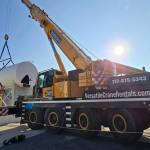
One real example of this class is Elliott Equipment’s 40142 BoomTruck: 40 tons of capacity, a 142-foot main boom, and a 207-foot maximum tip height once the optional 31 to 55-foot jib is added. It’s not a marketing number. It’s a real, in-production machine, and it illustrates a crane class that gets far less attention than it deserves.
What “40 to 70 Ton” and “207-Foot Extension” Actually Mean
Two numbers get thrown around loosely in crane conversations, and neither means what people usually assume.
The ton rating (40, 50, 70) is the crane’s maximum lifting capacity, but only at its shortest radius, closest to the truck. That capacity drops fast as the load moves farther out or higher up, which is the single most misunderstood fact in crane selection. A “70-ton crane” doesn’t lift 70 tons at 180 feet. It lifts a fraction of that.
The 207-foot figure is tip height, not boom length. It’s the boom fully extended plus a jib, a shorter lattice or telescoping extension bolted to the end of the main boom to add reach without adding a second crane. On the Elliott 40142, that’s a 142-foot boom plus a 31 to 55-foot jib. Take the jib off, and the same truck tops out at 142 feet. The jib is what turns a capable machine into one that can clear a mid-rise building or work an antenna mount without repositioning.
Why This Class Exists Between Two Extremes
Most construction and utility work doesn’t need a 300-foot crawler crane, and most of it can’t be handled by a standard 100 to 140-foot boom truck either. The 40 to 70-ton class with a 200-plus-foot jib configuration fills that gap on purpose.
A crawler or large all-terrain crane takes hours to mobilize, needs a permitted route, and requires enough site space for outriggers and counterweight that a lot of job sites simply don’t have. A boom truck in this class drives to the site on its own wheels, sets up outriggers in a fraction of the time, and still reaches high enough for the majority of mid-rise and infrastructure work. The tradeoff is real: less absolute capacity at extreme height than a purpose-built tower or crawler crane, in exchange for mobility, setup speed, and a footprint that fits an actual job site instead of an ideal one.
| Crane Type | Best For | Limitation |
| Boom truck (40-70 ton class) | Fast setup, tight or urban sites, mid-rise reach | Lower capacity at long radius or extreme height |
| All-terrain crane | Heavier commercial lifts, moderate mobility | Larger footprint, longer setup than a boom truck |
| Crawler crane | High-capacity, sustained multi-day lifting | Slow mobilization, needs significant site space |
| Tower crane | Ongoing multi-story construction | Fixed location, not mobile once erected |
Where This Equipment Class Actually Gets Used
The 207-foot figure isn’t a novelty spec. It maps directly onto specific, common project types.
Cell towers and telecom infrastructure. Antenna mounts and small-cell installations often sit well above what a standard boom truck can reach, but rarely need the capacity of a full tower crane. This class is a common fit for that exact gap. See our cell tower crane service for how that work gets planned.
Mid-rise rooftop HVAC and generator placement. A rooftop condenser or generator going onto a five, six, or seven-story building is often out of reach for a standard crane but doesn’t justify a crawler mobilization. See our HVAC & Generator Crane Service for how rooftop lifts get planned around building height and access.
Utility and storm restoration work. Downed poles, damaged lines, and storm-related hazards at height are frequently time-sensitive and site-constrained, exactly where a fast-mobilizing, high-reach truck earns its keep over a slower, larger crane. See our emergency crane service for how that response works.
General construction on taller structures. Steel, trusses, and material sets on buildings above typical residential height but below true high-rise territory fall squarely in this reach range. See our general construction crane services for that scope.
The Capacity-Reach Tradeoff, Explained Simply
Every crane’s real-world lifting ability is governed by a load chart, not the single ton number on the spec sheet. As the boom extends and the load moves farther from the truck, either horizontally (radius) or vertically (height with a jib), the safe lifting capacity drops, sometimes dramatically. A load that’s well within limits at 60 feet of radius can be far outside the crane’s rated capacity at 150 feet.
This is why the actual planning question is never just “is this a 40-ton crane.” It’s “what does this crane rate at the specific radius and height this job requires.” A crane operator or rigger reads the load chart for the exact configuration, boom length, jib angle, and radius before any lift happens. This is also exactly what ASME B30.5, the American National Standard for mobile and locomotive cranes, requires: a load rating chart specific to the crane’s configuration, clearly displayed and followed for every lift.
Picture a rooftop HVAC unit going onto a six-story office building. The unit weighs 6,000 pounds, well under any of these cranes’ rated capacity in the abstract, but the crane has to reach more than 150 feet above the ground while clearing the building’s edge. In that situation, the deciding factor was never the truck’s advertised 40-ton capacity. It’s whether the load chart allows 6,000 pounds at that specific boom length and radius, which is a very different number than what the crane can lift sitting at ground level with the boom retracted.
When This Class Isn’t the Right Answer
A 40 to 70-ton boom truck with a 207-foot reach is not the right equipment for every tall or heavy lift, and treating it as one is a planning mistake.
If the load is genuinely heavy at extreme height, a full high-rise steel package, a large piece of rooftop mechanical equipment at 200-plus feet, the available capacity at that radius on a boom truck may not cover it, even though the tip height technically reaches. Ground conditions matter just as much: outriggers on a boom truck need solid, level ground, and a site with poor bearing capacity or no room for outrigger spread may call for a crawler crane’s wider, track-based footprint instead. And for sustained high-volume lifting over multiple days on a single site, like structural steel erection on a genuine high-rise, a tower crane’s fixed, repeatable setup often outperforms a mobile unit brought in fresh each day.
The honest answer to “is this the right crane” is almost always “it depends on the load at that specific radius and height,” not the capacity number on the truck’s door.
How Crane Safety Standards Protect Every Lift
Every lift in this class falls under OSHA’s Cranes & Derricks in Construction standard, which governs equipment qualification, rigging, and operator competency, alongside ASME B30.5’s load-chart and configuration requirements. Operator certification for equipment in this class runs through accredited bodies, most commonly the NCCCO, the industry’s recognized certifying organization. Any provider bringing this class of crane to your site should be able to name the specific credential their operator holds, not just say they’re certified.