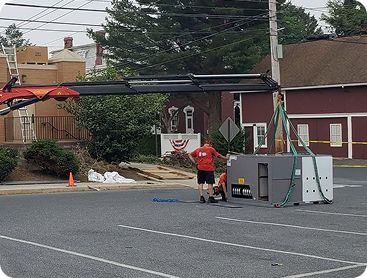

Versatile Crane Rentals provides crane support for tree care companies, landscapers, and property owners across Lancaster County, PA, handling the lifts that a bucket truck or ground crew can’t do safely on their own. That covers crane-assisted removal of large or hazardous trees, moving mature trees for transplanting, and placing boulders, water features, and hardscape material into yards with no truck access. We work alongside your tree crew or landscape contractor, and we run 24/7 for storm-damage and emergency tree situations that can’t wait for a normal schedule.
Have a tree or landscape job that needs a crane? Call (717) 875-5343 before you commit to a removal or install date. A quick conversation about the tree’s size, the site, and what’s nearby can save a canceled job later.
What Is Crane-Assisted Tree Removal?
Crane-assisted tree removal uses a crane to lift and lower large sections of a tree in a controlled pick, instead of dropping or free-falling them, which matters when a tree is too close to a house, power line, fence, or another structure to risk a standard felling cut.
When Do You Need a Crane for Tree or Landscape Work
You need a crane when a tree is too large, too hazardous, or too close to something valuable to remove piece by piece from the ground, or when a landscape feature like a mature tree, boulder, or water feature is too heavy or too far from truck access to move by hand or machine.
How Long Does a Tree or Landscape Crane Job Take
A single hazardous tree removal often runs a few hours once the crane is set. Larger removals with multiple picks, or landscape installs with several heavy pieces, run longer, and site access usually drives the timeline more than the size of any one piece.
What We Lift on Tree and Landscape Jobs
- Large or hazardous trees, removed in controlled sections
- Mature trees for relocation or transplanting
- Boulders and large landscape stone
- Water features, fountains, and heavy hardscape material
- Fallen or storm-damaged trees too large or too positioned for ground equipment
Why Tree and Landscape Crane Lifts Take More Planning
A standard tree removal drops sections to the ground and lets the crew buck them up from there. A crane-assisted removal exists because that option isn’t safe, usually because the tree leans toward a house, sits over a driveway, or has power lines running through its canopy. That means the rigging plan has to account for exactly where each section needs to go, not just how heavy it is, and the crane has to hold that section steady while the tree crew makes the cut.
Access is often the real limiting factor on tree and landscape jobs. Backyards, wooded lots, and tight suburban lawns weren’t built with crane pads in mind, and a lot of what looks like a simple pick from the driveway turns into a much longer reach once you account for fences, sheds, and the house itself. We walk the site before quoting so the crane size and setup match what’s actually there, not a generic estimate.
How a Tree or Landscape Crane Lift Works
- Site review: We walk the property, check overhead lines, structures, and access, and confirm where the crane can safely set up relative to the tree or the landscape feature.
- Rigging plan: We confirm the size and approximate weight of each piece being lifted, whether that’s a tree section or a boulder, and plan rigging points accordingly.
- Scheduling with your crew: We coordinate directly with your tree company or landscaper so the crane arrives when the crew is ready to cut, plant, or place.
- The lift: Our operator holds and moves each piece under control, working with your crew’s signals until it’s set or removed.
- Site cleared: Crane and rigging leave once the job is done, so you’re not paying for equipment sitting on the lawn.
We run mobile and hydraulic cranes sized to the property and the pick, not a single default machine used for every yard regardless of access.
Working with a crane instead of dropping and bucking a tree means less lawn and driveway damage, fewer surprises near the house or a neighbor’s fence, and a job your tree crew can finish in one visit instead of stopping to reassess mid-removal. That’s the difference a planned lift makes over a workaround.
Storm damage or a tree that’s already compromised? Call us directly. We prioritize hazardous and storm-related tree lifts because the risk only grows the longer a damaged tree sits.
Need Full Tree Removal, Not Just the Crane?
We provide the crane support, but if you need the whole job, from cutting to cleanup and stump grinding, our sister company BTS Tree Services handles full tree removal and property services across the same area.
Tree Crane Safety and Operator Certification
Tree care work carries some of the highest fatality rates of any industry, which is why the OSHA Tree Care Industry safety page exists as a dedicated resource covering hazards specific to tree work, including crane and rigging use. Tree crews typically follow ANSI Z133, the industry’s national arboricultural safety standard, alongside OSHA requirements. On our end, crane operator certification runs through accredited bodies like the NCCCO. If certification matters for your job or your insurance requires documentation, ask us directly and we’ll provide it before the crane arrives.
What Drives the Cost of a Tree or Landscape Crane Lift
- Tree size and position: a tree leaning toward a structure or power line takes more rigging care than one in an open yard.
- Number of picks: a single-section removal costs less than a multi-piece job or a full mature tree relocation.
- Site access: tight backyards, fences, or long driveways change the crane size and setup time needed.
- Scheduling: standard-notice jobs cost less than a same-day storm or hazard call.
We walk through these before quoting, so your price reflects the actual tree and property, not a flat per-tree rate.
Tree and Landscape Crane Service Area in Lancaster County
We provide tree and landscape crane service throughout Lancaster County, including Lancaster, Columbia, Lititz, Ephrata, Elizabethtown, New Holland, Harrisburg, Hershey, Lebanon, York, and Reading, with coverage extending to Carlisle, Coatesville, Downingtown, Hanover, Kennett Square, Middletown, Oxford, Palmyra, Parkesburg, Phoenixville, Pottstown, West Chester, and Wilmington. Check our full service area for exact coverage, or call and we’ll confirm your property before you schedule.