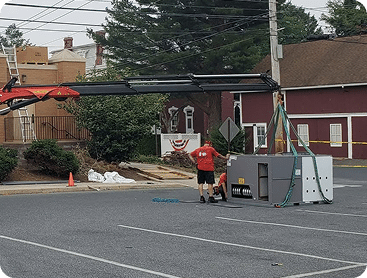
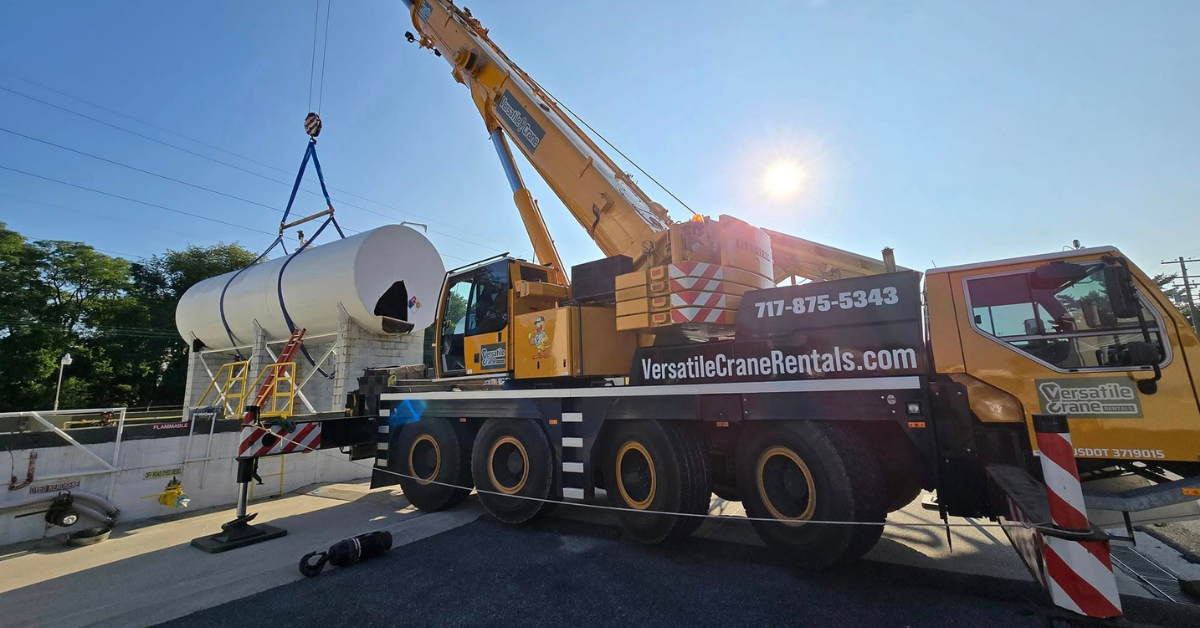
Versatile Crane Rentals handles HVAC and generator crane lifts for contractors, facility managers, and property owners across Lancaster County, PA, from single rooftop unit swaps to full generator installations at warehouses, distribution centers, hospitals, schools, manufacturing plants, and commercial office buildings. We size the crane to your equipment and your site, coordinate directly with your HVAC contractor or electrician, and run 24/7 so an emergency replacement never has to wait for business hours.
Planning a rooftop HVAC replacement or a generator install? Call (717) 875-5343 before you finalize the equipment order. A five-minute conversation about access and weight now can save a rescheduled lift later.
What Is an HVAC Crane Lift
An HVAC crane lift uses a mobile or hydraulic crane to set a rooftop condenser, package unit, or chiller in place, usually because the unit is too heavy or the roof access too limited for a standard rigging crew. It’s routine work for us, not a specialty add-on.
When Do You Need a Crane for HVAC or Generator Work
You need a crane when the equipment can’t reach its final position by forklift, hoist, or hand rigging alone. That covers most rooftop replacements, any commercial or industrial generator install, and equipment going into tight mechanical yards or over an occupied building.
How Long Does an HVAC or Generator Lift Take
A single rooftop unit typically runs a few hours from crane setup to teardown. Generator placements and multi-unit rooftop jobs run longer, and site access affects the timeline more than the equipment itself does.
What We Lift
- Rooftop HVAC units, condensers, and package units
- Commercial and industrial generators
- Chillers and air handlers
- Mechanical equipment and ductwork beyond standard rigging capacity
Why These Lifts Take More Planning
A rooftop unit has to clear parapet walls and existing curbs, often with the crane sitting in a lot that wasn’t built with a crane pad in mind. Get the crane size wrong and you either can’t make the reach, or you’ve booked a machine so large it takes over half the site. Generators bring the opposite problem: concentrated weight in an awkward shape, landing on a pad with tight tolerances next to the building’s electrical service. We plan for both before the truck ever leaves the yard, which is what keeps a lift day from turning into a lift week.
Ground conditions and weather change the plan too. Soft ground under an outrigger pad can shift a crane’s rated capacity as much as the load itself does, and high wind can push a scheduled lift to a different day entirely. On any lift with real weight or reach involved, a designated lift director and signal person run the job alongside the operator, and the rigging gets inspected before it ever takes a load. None of that is optional extra service. It’s what keeps a routine HVAC or generator lift routine.
How the Lift Works
- Site review: We check access, overhead lines, and ground conditions. The limiting factor is usually where the crane can set up, not what it can lift.
- Rigging plan: We confirm weight, dimensions, and rigging points for your specific unit or generator, so the right-size crane shows up the first time.
- Scheduling with your crew: We coordinate with your HVAC contractor, GC, or electrician so the lift fits your project instead of stalling it. That coordination is what keeps the rest of your crew working instead of standing around waiting on equipment.
- The lift: Our operator sets the equipment and confirms final positioning with your team before anything is unhooked.
- Site cleared: Crane and rigging leave once placement is confirmed, so you’re not paying for idle equipment.
We use mobile and hydraulic cranes matched to the job, with rigging planned around load charts, spreader bars, and shackles rated for the specific lift, not a one-size-fits-all setup.
The real payoff of that planning shows up on your schedule, not just at the crane. A rigging plan built ahead of time means your electrician isn’t standing around waiting on a delayed lift, your HVAC contractor isn’t rebooking a crew, and your building isn’t down a rooftop unit or a generator longer than it has to be. That’s the difference between a crane company that shows up and one that keeps your whole project on track.
Coordinating multiple units across one site? We can plan the full sequence in one mobilization instead of billing separate trips for each unit. Call ahead and tell us what’s on the schedule.
Complete Crane Services Beyond HVAC
If the job includes crane work outside HVAC or generators, structural steel, or general material handling, we handle that too. See our general construction crane services for the rest of the scope, and plan it under one visit instead of two separate mobilizations.
Crane Safety Standards, Operator Certification, and Compliance
Crane work in construction falls under OSHA’s Cranes & Derricks in Construction standard, covering equipment qualification, operator competency, and site setup. Operator certification runs through accredited third-party bodies rather than a company’s own sign-off, most commonly the NCCCO, the industry’s recognized certifying organization. If certification matters to your project, ask us directly which credential your operator holds and what coverage is in place for the lift. We’ll answer both specifically when you call, not with a generic “yes, we’re covered.”
What Drives the Cost
- Crane size and reach: tight lots or limited roof clearance often need a larger or more specialized crane than open access would.
- Rigging complexity: a straightforward condenser rigs differently than a large package unit or an odd-shaped generator.
- Site access: parking limits, overhead lines, and street closures add time and sometimes permitting.
- Scheduling: standard lead time costs less than a same-day emergency call.
We walk through these before quoting, so the number reflects your actual site, not a flat hourly rate.
Areas We Serve
We cover HVAC and generator crane work throughout Lancaster County, including Lancaster, Columbia, Lititz, Ephrata, Elizabethtown, New Holland, Harrisburg, Hershey, Lebanon, York, Reading, and the surrounding region out to Wilmington and West Chester. That includes rooftop replacements on manufacturing plants and distribution centers along the Route 30 and Route 283 corridors, generator installs at hospitals and schools that can’t afford downtime, and standard HVAC swaps for office buildings and retail sites throughout the county. Check our full service area for exact coverage, or call and we’ll confirm your site before you commit to a lift date.